What Is Kiln Dried SPF Lumber and Why It Matters
If you’ve spent any time browsing the lumber yard or scrolling through building material specs, you’ve probably come across the label “KD-SPF” stamped on boards and wondered what it actually means. Spoiler: it matters more than you might think.
Kiln dried SPF lumber is one of the most widely used building materials in residential construction, but few people outside the trades truly understand what sets it apart from other wood options. SPF stands for Spruce, Pine, and Fir, a grouping of softwood species that share similar structural properties. The “kiln dried” part refers to a controlled drying process that dramatically changes how the wood performs over time.
In this guide, we’re going to break down exactly what kiln dried SPF lumber is, how the drying process works, and why choosing the right moisture content in your lumber can mean the difference between a solid, long-lasting build and one that warps, cracks, or shifts after the job is done. Whether you’re framing walls, building a deck, or tackling a structural project, this is information you’ll want in your back pocket.
Breaking Down SPF: What Is Actually in the Mix
If you’ve ever grabbed a stick of framing lumber and noticed it was stamped “SPF,” you might have assumed it was a single species. It’s not. SPF is actually a species grouping that bundles three distinct wood types together: spruce, pine, and fir. These species grow in overlapping regions across Canada’s boreal and montane forests, and because they share close enough density, grain structure, and mechanical properties, they can be graded and sold interchangeably for most structural applications.
Each species does bring something a little different to the table, though. Spruce is the lightest of the three, with a fine, uniform texture and straight grain that makes it easy to work with and pleasing to look at. Pine steps in with added stiffness and strong nail-holding capacity, which matters when you’re driving thousands of fasteners into a framed wall. Fir rounds out the blend with moderate density and hardness, contributing to the overall dimensional stability of the group.
The SPF designation itself traces back to the National Lumber Grades Authority (NLGA), the Canadian grading body that formalized this grouping to reflect how these species are actually harvested and milled together across North America.
One distinction worth knowing: SPF and SPFs are not the same thing. SPFs (with a lowercase “s”) is a U.S.-specific grouping that includes slightly different species and carries its own design value tables. The differences in allowable spans can be small, but for engineered applications or precision remanufacturing work, those variations matter.
Speaking of remanufacturing, if you’re sourcing kiln dried SPF lumber for anything beyond basic framing, like custom mouldings, furniture components, or precision cut stock, the “SPF” label alone isn’t enough information. Species composition affects machining behavior, staining consistency, and how the wood responds to tight tolerances. Knowing what’s actually in your bundle helps you predict yield, finish quality, and performance before the first board hits the saw.
What Kiln Drying Actually Does to Lumber
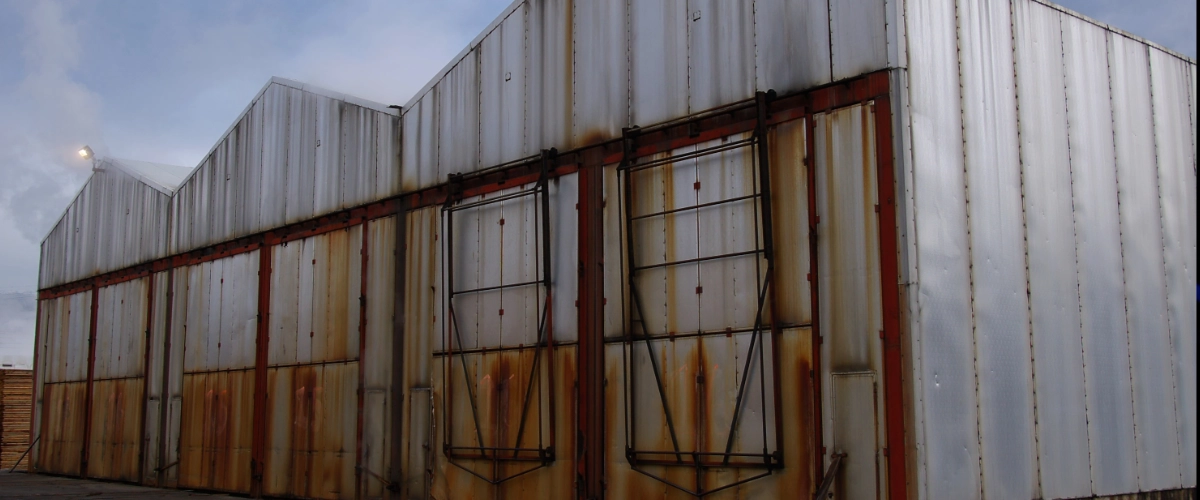
Kiln drying is not just a label on a lumber stamp. It is a controlled industrial process that fundamentally changes how wood behaves once it leaves the mill. Understanding what actually happens inside that kiln helps you make smarter decisions about the material you specify, buy, or process.
The goal is simple: get moisture content below 19% MC, which is the threshold that officially separates “dry” lumber from green material under the American Softwood Lumber Standard. In practice, most kiln-dried SPF hits closer to 15% or lower, and precision remanufacturing applications often push for 6 to 8% MC. Green lumber can start at 30% MC or well above depending on the species and harvest conditions. Above roughly 28 to 30% MC, what is called the fiber saturation point, the wood cell walls are still fully saturated. Once you drop below that point, the wood starts to shrink, and controlling that shrinkage is exactly what the kiln process is designed to do.
How the Process Actually Works
Lumber is stacked in a sealed chamber with spacers between each layer to allow airflow. High-velocity fans circulate heated, humidity-controlled air across every board surface. The schedule is staged: the kiln starts with higher humidity to warm the wood gradually without causing surface checking, then progressively raises temperature and lowers humidity to drive out first the free water, then the bound water held in cell walls. A final equalization and conditioning phase relieves internal stresses before the load is pulled. For standard SPF dimension lumber, the full cycle typically runs 24 to 36 hours, though thicker stock or species like sub-alpine fir can push that significantly longer.
Stability, Defects, and Why It Matters
Lower MC directly translates to fewer problems after installation or processing. Cupping, bowing, twisting, and checking all trace back to uneven or excessive moisture movement. When the outer layers of a board dry faster than the core, tension builds and defects follow. A properly kiln-dried board that is already close to its in-service equilibrium moisture content has far less movement left to give.
That said, kiln drying matters differently depending on what you are building. Framing applications tolerate some residual movement. A KD19 stamp is sufficient for most structural work, and minor shrinkage after installation is factored into standard practice. Remanufacturing is a different story entirely. If you are running SPF through a moulder, ripping it into cut stock, or producing furniture components, you need tighter and more consistent MC across the load. Inconsistent moisture content causes warping in finished profiles, glue joint failures, and machining rejects that cost real money.
Heat Treatment Certification
One practical byproduct of kiln drying is heat treatment certification. For lumber destined for international shipment or certain industrial packaging applications, ISPM 15 compliance requires wood to reach a core temperature of 56°C for at least 30 minutes. Many conventional kilns hit this threshold during the drying process, producing what is stamped as KDHT, kiln-dried heat-treated. If your application requires it, ask specifically for a heat treatment certificate from a registered facility, not just the grade stamp. The stamp confirms the process was used; the certificate documents the temperature and time logs that regulatory authorities and importers actually want to see.
SPF Grades and Dimensions: What You Actually Need to Know
Not all kiln dried SPF lumber is created equal, and knowing the difference between grades, surface treatments, and certified dimensions can save you a lot of headaches on the job site or in the shop.
#2 & Better is the grade you’ll encounter most often for structural framing. It covers Select Structural, No. 1, and No. 2 material in a single combined designation, with strength values based on the lowest grade in the mix. It allows moderate knots, some wane, and minor surface variation, which is perfectly acceptable for joists, rafters, studs, and trusses where the wood is hidden inside a wall or floor system. When appearance matters, such as exposed beams or visible interior framing, Premium grade is worth the step up. It carries tighter knot restrictions, reduced wane, and a cleaner overall look while maintaining comparable structural performance.
Most dimensional SPF you’ll find at a distributor or retail yard is sold S4S, meaning it has been surfaced on all four sides after drying. That smooth, consistent finish comes at a cost to size. A nominal 2×4 is actually 1½ inches by 3½ inches. A 2×6 measures 1½ by 5½, and a 2×10 comes in at 1½ by 9¼. Always work from actual dimensions in your plans, not nominal labels.
Standard stock typically runs 2×4 through 2×12 in lengths from 8 to 20 feet, with precut stud lengths also widely available. Longer or non-standard sizes often require special ordering through a distributor.
The PLIB stamp on your lumber is not just a formality. The Pacific Lumber Inspection Bureau has been providing third-party grading and certification since 1903, and its stamp signals consistent grade verification, confirmed moisture content, and independent quality oversight. It gives you confidence that the grade marked on the board actually reflects what you are buying.
When standard grades and dimensions fall short, such as for tight-tolerance millwork, architectural applications, or specialty industrial use, custom grading and remanufacturing fill the gap efficiently. Precision resawing, custom planing, and appearance-specific grading let you get exactly the spec you need without compromise.
SPF vs. SYP, Douglas Fir, and Hemlock: An Honest Comparison
Now that you understand what SPF is and how grading works, it helps to know where it stands against the other species you’ll commonly see at the lumber yard or in remanufacturing specs. The honest answer is that no single species wins across every category, but understanding the tradeoffs makes your material choices a lot more intentional.
SPF holds a clear advantage in weight, workability, and cost for most North American applications. Its specific gravity typically falls in the 0.40 to 0.45 range, making it noticeably lighter than the competition. On a job site or in a shop, that translates to less fatigue during handling, easier fastening with hand tools, and fewer split edges when nailing close to board ends. For high-volume residential framing or remanufacturing runs, SPF is almost always the economical default, and a direct species comparison confirms why it consistently earns that reputation.
Southern Yellow Pine runs denser and stiffer, with higher design values for bending and compression. That makes it a legitimate choice for heavy structural members, high-load beams, or treated outdoor applications like decks. The tradeoff is real though; it is harder to work with hand tools, heavier to move, and can cost significantly more depending on your region.
Douglas Fir offers the best stiffness-to-weight ratio of the group, with a modulus of elasticity that often runs into the 1.7 to 1.9 million psi range. It is the go-to when long spans or deflection control are the primary concern, such as floor joists, ridge beams, or engineered assemblies. As this framing species breakdown highlights, Douglas Fir earns its premium price in performance-critical situations.
Hemlock sits comfortably between SPF and Douglas Fir. It handles almost as easily as SPF, with slightly better strength values in several graded comparisons, and it shows up regularly in both framing and remanufacturing applications like millwork and moldings.
For standard residential framing, interior work, or most remanufacturing projects, SPF remains the strong default. When your application involves heavy structural loads or long unsupported spans, it is worth pricing out SYP or Douglas Fir before committing.
Where Standard Kiln Dried SPF Falls Short
Off-the-shelf kiln dried SPF is genuinely excellent for what it was designed to do. Standard framing, wall studs, floor joists, roof trusses, and similar structural applications are exactly where commodity KD SPF earns its place. It meets building codes, ships in volume, and is priced to move. But the moment your project steps outside those boundaries, the limitations become real and they show up fast.
The first place commodity SPF falls short is dimensional precision. Standard retail SPF is produced to nominal sizes with acceptable industry variances that work fine for framing but not for furniture builds, custom crating, or industrial components where fit and consistency actually matter. If you need stock ripped to an exact width, trimmed to a specific length, or surfaced to a non-standard thickness, no big-box retailer or commodity distributor is going to help you. Those products simply do not exist on their shelves.
Moldings and specialty profiles are another clear gap. Creating tongue-and-groove, custom bevel, or proprietary patterns requires dedicated moulding equipment and an in-house knife shop. Commodity suppliers sell dressed lumber; they do not run profiles. That distinction matters a lot when you are speccing millwork, custom packaging, or any application where a specific profile is part of the product design.
The sharpest limitation, though, is tolerance. Retail SPF carries variances that are perfectly acceptable for construction but completely unworkable for precision manufacturing. A 1/64-inch tolerance is not a retail product. It is the outcome of precision resawing, controlled drying to 12% MC or below, and calibrated surfacing through equipment designed for remanufacturing, not rough distribution.
This is exactly the gap that Prime Forest Remanufacturing was built to fill. With over 75,000 custom options, Baker resaws running a 1/16-inch kerf for minimal waste ripping, and tolerances held as tight as 1/64 inch across SPF and multi-species stock, the capabilities are in a completely different category than commodity supply. When your specs require documented moisture content, certified grading, or a dimension that does not exist in standard inventory, remanufacturing is not a luxury; it is the only path to a product that actually meets spec.
Full-Service Custom Processing: From Kiln Dried Stock to Finished Product
When standard kiln dried SPF gets you 80% of the way there but you need the other 20%, that’s where full-service remanufacturing becomes genuinely useful. Prime Forest Remanufacturing handles the entire chain in-house, from raw kiln dried stock through to a finished, packaged product built to your exact spec. That means PLIB-certified custom grading, kiln drying with heat treatment certificates issued on every load, sorting, ripping, trimming, moulding, finger jointing, planing, inline sanding, and custom packaging, all under one roof in Sweet Home, OR. The advantage of that integration is consistency; when one operation controls each step, there is far less room for spec drift between processes.
On the dimensional side, surfacing capability runs up to 4 inches thick by 12 inches wide, which opens up a wide range of outputs from a single SPF supply. Whether you need cut stock for a millwork run, custom patterns for a moulding profile, or lamstock for engineered wood components, the same species can be processed to very different end specs without sourcing multiple products.
Order size is often the sticking point with commodity suppliers, who tend to prioritize high-volume runs and turn away smaller or one-off projects. Prime Forest operates with no minimum order for certain species and low minimums of around 50 to 60 board feet for others, including SPF. That directly removes friction for smaller buyers and custom projects that would otherwise get ignored.
For buyers with documentation requirements, FSC and PEFC chain of custody certification is available, covering commercial, institutional, and export projects where sustainable sourcing needs to be verified on paper.
The family-owned structure matters here in a practical sense. The white-glove service approach means your spec gets reviewed carefully before production starts, not after a miscut shipment shows up at your dock.
SPF Pricing and Supply: What the Market Looks Like Right Now
If you’re budgeting for a project or trying to plan procurement, the current SPF market is something you need to pay attention to. According to Farm Credit East’s Forest Products Outlook, SPF prices climbed roughly 14% in 2025, driven by a combination of mill closures and significant tariff and duty pressures on Canadian lumber imports. That increase pushed the national framing lumber composite price to approximately $872 per MBF in early 2026, which is a number that hits hard whether you’re a builder pricing a project or a remanufacturer sourcing raw stock.
On the supply side, things are not loosening up anytime soon. North American softwood lumber capacity is projected to see a net drop of approximately 1.3 billion board feet in 2026 as mills continue to rationalize operations. That is a meaningful contraction that tightens the pipeline across the board.
What makes the current situation interesting is that demand is still growing despite the supply pressure. North American softwood lumber consumption is projected at 59.9 BBF in 2026, up 0.7% year-over-year, with further growth to 61.5 BBF expected in 2027. Housing starts and repair and remodel activity are expected to be the primary drivers of a potential price recovery in the second half of 2026, so the back half of the year bears watching closely.
Zooming out, the long-term picture for kiln-dried stock specifically is strong. The kiln-dried dimensioned lumber segment is projected to grow from roughly $14.5 billion in 2025 to approximately $26 billion by 2033, a Compound Annual Growth Rate of about 7.45%. That kind of trajectory reflects real, sustained demand for quality dried lumber rather than just short-term market noise.
What to Ask When Sourcing Kiln Dried SPF Lumber
Sourcing kiln dried SPF lumber the right way starts with asking better questions before a single board ships. The label alone does not tell the whole story, and a few targeted asks upfront can save you a significant amount of rework, waste, and frustration down the line.
Start with documented moisture content. A reputable supplier should be able to hand you MC certifications confirming the lumber was actually dried to a specific level, whether that is KD19 for standard framing applications or KD15 for tighter interior uses. A stamp that just says “KD” meets a minimum threshold, but it does not guarantee uniformity across a full pack. Ask for batch-specific test reports, not just the grade stamp.
Verify grading standards and third-party certification. PLIB-certified grading or an equivalent accredited agency gives you a documented baseline for consistency across an entire order. This matters especially when you are ordering volume or running material through secondary processing, because variability in defect limits or structural ratings compounds quickly at scale.
Request heat treatment certificates when they apply. If your material is headed overseas or into any application requiring phytosanitary compliance, you need HT documentation confirming the lumber met ISPM-15 standards. Not all KD lumber is heat treated, so confirm both independently.
Clarify your tolerance requirements before ordering. Standard S4S gets you close, but if your application demands tighter dimensional consistency, have that conversation with your supplier before assuming retail stock will work. Ask whether remanufacturing options are available to hit the spec you actually need.
Finally, understand the full processing picture. Ask about minimum order flexibility, lead times for custom dimensions, and whether the supplier can handle drying, grading, surfacing, and packaging under one roof. Managing multiple vendors to get a finished product adds coordination time and cost that compounds fast.
The Bottom Line on Kiln Dried SPF Lumber
Kiln dried SPF lumber earns its place as a go-to material because it genuinely delivers on the fundamentals: solid strength-to-weight ratio, good workability, dimensional stability after drying, and a price point that holds up against alternatives. When you specify it correctly and source it from a supplier who knows what they’re doing, it performs reliably across framing, remanufacturing, and a wide range of custom applications.
The knowledge you bring to the table matters just as much as the material itself. Understanding what’s in the species mix, what moisture content standards actually mean for your project, and how grading distinctions translate to real-world performance puts you in a fundamentally stronger position when you’re evaluating bids, reviewing certifications, or pushing back on a supplier who can’t answer basic questions about their stock.
Standard retail SPF handles the basics well, and there’s no reason to overcomplicate a straightforward framing job. But when your project calls for tight tolerances, non-standard dimensions, certified documentation, or value-added processing like ripping, moulding, or finger-jointing, commodity stock simply wasn’t built for that. That’s where a remanufacturing partner changes the equation.
Prime Forest Remanufacturing bridges that gap directly. With over 75,000 custom options, tolerances as tight as 1/64 inch, PLIB-certified grading, and full-service processing under one roof, they handle what standard suppliers can’t. If your application demands more than off-the-shelf SPF can offer, that’s exactly the kind of precision and flexibility worth having in your corner.
Conclusion
Understanding kiln dried SPF lumber is not just trivia for contractors; it is knowledge that directly impacts the quality and longevity of any build. To recap the essentials: SPF groups three compatible softwood species under one reliable standard, the kiln drying process removes excess moisture to prevent warping and shrinkage, and proper moisture content is the single biggest factor in whether your framing stays true over time.
Whether you are a seasoned builder or tackling your first major project, choosing KD-SPF lumber gives you a measurable advantage in structural stability and performance. Do not leave your next purchase to guesswork. Check the grade stamp, verify the moisture content, and source from a reputable supplier. The right lumber at the start means fewer problems down the road, and a finished project of which you can genuinely be proud.