
Precision Wood Machining: What It Is and How It Works
Have you ever run your hand across a perfectly crafted wooden cabinet or staircase and wondered how every joint fits together so flawlessly? That level of craftsmanship doesn’t happen by accident. It’s the result of precision wood machining, a process that takes woodworking beyond basic cuts and transforms it into a science of accuracy and repeatability.
If you already have some woodworking experience under your belt, you’ve probably hit a point where eyeballing measurements just doesn’t cut it anymore. That’s exactly where precision wood machining becomes a game changer. It combines specialized equipment, careful technique, and a deep understanding of how wood behaves to produce parts and pieces that meet exact specifications every single time.
In this tutorial, we’re going to break down what precision wood machining actually means, how the process works from start to finish, and which tools and techniques are involved. Whether you’re looking to level up your shop skills or better understand industrial woodworking methods, you’ll walk away with a solid grasp of what separates precise work from simply good work. Let’s get into it.
What Actually Makes Wood Machining ‘Precise’
Let’s start with the basics, because “precision” gets thrown around a lot in woodworking circles without much explanation of what it actually means in practice.
Precision comes down to two things: tolerance and repeatability. Tolerance is simply the allowable deviation from a target dimension. If you’re cutting a board to exactly 1.5 inches thick, your tolerance defines how far off that cut can be before the piece fails to meet spec. In general CNC wood machining, typical industry tolerances run around 0.5 to 1mm, which is already tighter than most manual processes can consistently achieve. In lumber remanufacturing, a tolerance of 1/64 inch (approximately 0.0156 inches) pushes that standard significantly further, and it’s the kind of accuracy that directly affects yield, fit, and how well parts work together downstream.
Repeatability is the other half of the equation, and honestly, it might be the more important one. A single accurate cut is a good start, but it doesn’t tell you much on its own. What actually defines precision machining is whether every cut across an entire production run lands within that same tolerance window. CNC systems earn their reputation here because programmed, automated control eliminates the variability that comes with manual work. As Xometry’s breakdown of CNC vs. manual machining explains, even skilled operators introduce inconsistency over time through fatigue, subtle shifts in feed pressure, and setup variation.
That contrast with standard mill cuts matters. Manual sawmill methods can produce accurate individual pieces, but holding consistent tolerances at volume is a different challenge entirely. Blade deflection, log stress, and inconsistent feeding can push variation well past 1/32 inch across a run. CNC-driven remanufacturing addresses that directly through precise, repeatable machine control at scale.
To put the broader context in perspective, the global CNC machine market is projected at approximately USD 93 billion in 2026, fueled by automation and cross-industry demand for precision manufacturing. That growth reflects a simple reality: tight-tolerance machining has become a baseline expectation, not a premium offering, and wood products are no exception.
Throughout the rest of this post, we’ll look at precision as a combination of tolerance, repeatability, and the upstream processes, including material preparation, kiln drying, and machine calibration, that protect both. Getting those elements working together is what separates truly precise wood machining from a lucky cut.
The Processes That Make Precision Possible
Precision wood machining is really a collection of individual operations working together, and understanding each one helps you see why the whole system produces such consistent results.
Ripping, planing, and trimming form the foundation of dimensional accuracy. Ripping cuts boards along the grain to achieve exact widths, using the wood’s natural fiber direction to produce clean, parallel edges. Planing comes next, flattening and smoothing the faces of a board while removing any cupping, bowing, or twist that rough-sawn lumber tends to carry. Trimming then cuts each piece to its exact final length. Each step builds on the last, and together they’re what gets you to consistent width, thickness, and length across every single board in a run.
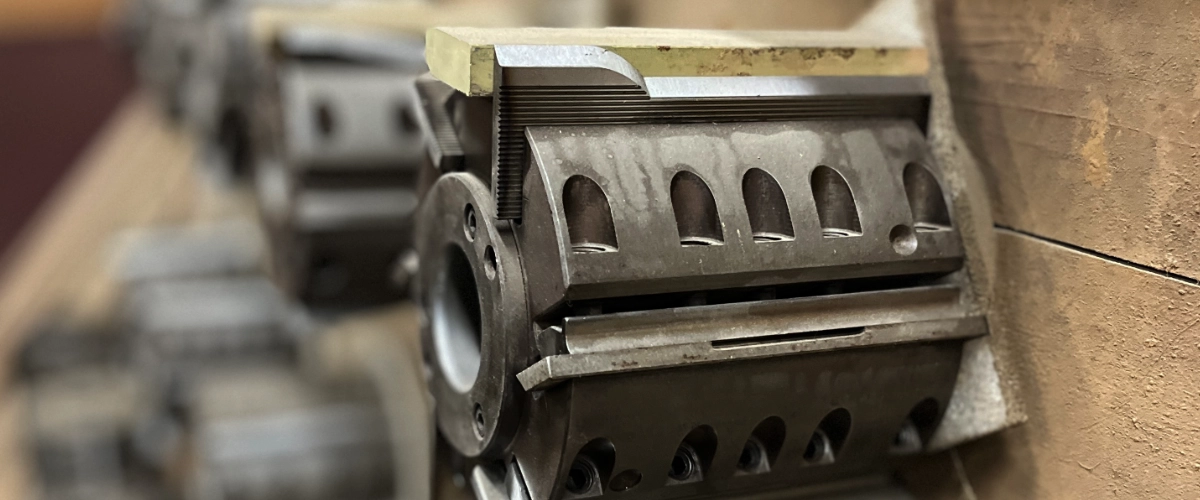
Moulding and custom knife work are where things get genuinely interesting for anyone working with complex profiles. Moulding machines shape edges and faces into profiles like crown moulding, tongue-and-groove, or baseboards, all while holding tight tolerances throughout the pass. Custom knife work takes that a step further by grinding knives to a specific shape that doesn’t exist in any standard tooling catalog. That means you can produce a completely one-of-a-kind architectural profile, something nobody else offers off the shelf, while still maintaining the dimensional consistency you need for clean installation and long-term performance.
Finger jointing deserves its own mention as a structural precision process. Interlocking fingers cut into shorter wood segments have to align within very tight tolerances for the glued joint to develop full strength. Get the alignment wrong, even slightly, and you compromise the integrity of the entire board. Done right, finger-jointed lumber can actually exceed the strength of a single solid piece.
Here’s the part that often gets overlooked: sequencing matters just as much as the individual operations. Running a board through planing before ripping gives you a flat, stable reference surface that produces cleaner, more accurate final dimensions. Skipping that step or reversing the order introduces variability that compounds through every operation that follows.
That repeatability at every stage is exactly what makes it possible to offer more than 75,000 custom configurations, including over 25,000 options for lumber specifically. Without dialed-in planing and profiling processes that perform consistently at production volumes, that kind of scale simply isn’t achievable. Every custom order depends on the same foundation of controlled, sequenced operations producing the same result, run after run.
Why Kiln-Drying Is Part of the Precision Equation
Here’s something that most people overlook when they talk about precision wood machining: cutting accuracy only holds if the wood itself is stable. You can achieve a perfect 1/64-inch tolerance at the machine, but if the board absorbs moisture from the air and expands even slightly before installation, that tolerance is gone. Wood is hygroscopic, meaning it constantly exchanges moisture with its surrounding environment. As it takes on moisture, it swells. As it releases moisture, it shrinks. A rough rule of thumb is that wood dimensions shift about 1% for every 3% change in moisture content, and in an uncontrolled environment, that adds up fast.
This is exactly why kiln-drying lumber is a non-negotiable part of the precision equation, not just a nice-to-have add-on. Kiln-drying reduces the moisture content of lumber in a controlled chamber by carefully managing temperature, humidity, and airflow. The goal is to bring the wood down to a target moisture content that matches the environment where it will ultimately live. Interior millwork and precision components typically target 6 to 8% moisture content. When wood arrives at that stable equilibrium before machining, the dimensions you cut are the dimensions that hold.
Heat treatment often works alongside kiln-drying and brings its own set of advantages worth understanding. The process heats wood to a core temperature of 56 degrees Celsius for a minimum of 30 minutes, which eliminates insects, larvae, fungi, and other pathogens. For anyone working with lumber destined for international markets or regulated applications, this matters because it satisfies ISPM-15 phytosanitary compliance requirements. It also adds a layer of dimensional stability by lowering the wood’s natural tendency to absorb and release moisture over time.
The practical stakes are straightforward. Machining green or poorly dried stock to tight tolerances is effort wasted, because the material will move after the cut. Moisture content directly affects machining tolerances, and suppliers who understand this treat kiln-drying as a quality checkpoint built into the workflow, not a step that gets rushed or skipped under schedule pressure. That understanding is what separates a supplier who delivers true precision from one who focuses only on what happens at the cutting stage.
Species Matters: Not All Wood Behaves the Same Under Tight Tolerances
Not all wood is created equal, and that reality has a direct impact on precision wood machining outcomes. Every species carries its own density, grain structure, and moisture absorption rate, and each of those characteristics affects how a board behaves when it hits a blade or a planer head. Ignoring these differences is one of the fastest ways to end up with parts that are out of spec, even when your equipment is dialed in perfectly.
Douglas Fir: The Reliable Workhorse
Douglas Fir is a great example of a species that performs well under tight tolerances. It’s a dense, straight-grained softwood with a Janka hardness around 600 lbf, which gives it predictable, consistent behavior during precision cuts. Its grain runs clean and uniform, which means fewer surprises like tear-out or grain deviation mid-cut. Once it’s properly kiln-dried to equilibrium moisture content, it resists movement and holds its dimensions reliably, making it a go-to for structural and dimensional applications where consistency isn’t optional. According to research on wood properties for CNC woodworking, density and grain structure are among the most critical factors in determining how cleanly a species machines.
Western Red Cedar: A Different Set of Rules
Western Red Cedar sits at the opposite end of the spectrum in several ways. It’s lighter, more porous, and has a lower density than Douglas Fir, which means it absorbs and releases moisture more readily when conditions aren’t controlled. The good news is that it actually has very low shrinkage factors, making it naturally stable once it’s properly dried. The catch is getting it there. Without careful kiln-drying to the right moisture content, Cedar can move on you after machining, which defeats the purpose of precision cutting entirely. It machines smoothly and finishes well, but it demands a species-aware approach rather than a generic one.
Why This Knowledge Sets Suppliers Apart
This is where supplier expertise becomes genuinely valuable. A machining partner who understands species-specific behavior will adjust feeds, speeds, drying protocols, and tooling accordingly. One applying a one-size-fits-all method will produce inconsistent results, especially as tolerances tighten. Working with a supplier who has deep, hands-on experience across multiple species means you get guidance on which material actually fits your project’s tolerance requirements, load conditions, and environment. That kind of informed recommendation reduces risk, cuts waste, and leads to better outcomes across the board.
How Sustainability and Precision Actually Work Together
There’s a common assumption in the woodworking industry that sustainability and precision are two separate conversations: one for the environmental team, one for the shop floor. That assumption is worth questioning, because in practice, these two priorities share the same foundation.
FSC (Forest Stewardship Council) and PEFC (Programme for the Endorsement of Forest Certification) Chain of Custody certifications do something specific and underappreciated. They require companies to maintain a documented, audited record of where wood comes from, how it’s handled, and how it moves through the supply chain from forest to finished product. That’s not a marketing exercise; it’s a systems discipline. You need clear protocols, consistent documentation, and regular third-party verification to hold those certifications.
Here’s where it connects to precision machining: the same operational mindset that keeps chain-of-custody records accurate is the mindset that keeps tolerances tight. Suppliers who build robust tracking systems for certification purposes tend to carry that rigor into their machining specs, quality control checkpoints, and material handling procedures. Process discipline doesn’t stop at the certification audit; it shows up in how consistently parts come off the machine.
This matters more heading into 2026 than it did even a few years ago. Consumer demand for responsibly sourced products is growing, regulatory pressure is increasing, and reshoring trends are pushing buyers toward domestic suppliers who can demonstrate both quality and accountability. FSC and PEFC Chain of Custody certification uptake is rising as a direct result, with certifications becoming a standard procurement requirement in many segments rather than a nice-to-have.
For buyers, a supplier holding recognized sustainability certifications alongside tight tolerance capabilities is telling you something important about how that company operates overall. It signals documented systems, consistent processes, and a serious approach to accountability. That’s not environmental optics; it’s a reliable indicator of operational quality across the board.
What to Look for in a Precision Wood Machining Partner
Choosing the right precision wood machining partner is one of the most consequential decisions you’ll make on a custom project, and it’s worth asking the right questions before you commit. Here’s what to evaluate.
Get tolerance guarantees in writing. Ask the supplier specifically what dimensional tolerances they guarantee, not just what their equipment is theoretically capable of. General CNC wood machining typically operates in the 0.5 to 1mm range, which reflects the natural variability of wood as a material. A supplier consistently hitting 1/64-inch (approximately 0.0156 inches) on dimensional lumber is operating at a meaningfully tighter standard, and that difference shows up in fit, finish, and assembly accuracy. If a supplier can’t give you a written number, that’s a signal worth taking seriously. You can also reference woodworking tolerance benchmarks to ground your expectations before those conversations.
Ask them to walk you through their full process. A supplier worth working with should be able to explain their workflow from species selection and drying through machining and finishing in plain terms, without vague language or deflection. Process transparency matters because wood behaves differently at each stage, and a supplier who understands and controls each variable is far more likely to deliver consistent results across batches. If they can’t explain how they manage moisture content before cutting, that gap will show up in your final product.
Check for FSC and PEFC Chain of Custody certification. These certifications aren’t just environmental checkboxes. They signal supply chain discipline, traceability, and responsible sourcing practices that tend to correlate with overall operational rigor. If your project has sustainability requirements or end-market expectations around responsible sourcing, dual certification gives you the documentation to back it up.
Look at configuration range and minimum order policies. A supplier offering a wide range of custom options with no minimum order requirements on core species is genuinely better positioned to serve smaller-volume or highly specific projects. That flexibility means you don’t have to compromise on spec to meet a volume threshold.
Confirm species-specific experience. General CNC capability is not the same as hands-on experience with Douglas Fir, Western Red Cedar, or whichever species your project requires. Species behavior under tight tolerances varies considerably, and a supplier with real depth in your target species will anticipate problems before they become costly.
Where Precision Wood Machining Is Headed in 2026
The precision wood machining industry isn’t standing still, and if you’re sourcing custom wood components, understanding where things are headed helps you make smarter decisions today.
The global woodworking machinery market is projected to grow from approximately USD 5.23 billion in 2025 to over USD 8.5 billion by 2034, at a CAGR of 5.1 to 6.5%. That kind of sustained investment signals something important: manufacturers across the industry are actively upgrading their equipment and capabilities. When capital flows into precision manufacturing at that scale, the overall quality floor rises, and buyers benefit directly.
One of the most significant shifts happening right now is AI integration inside CNC control systems. Rather than running static cutting programs, newer systems use real-time sensor feedback to adjust cutting paths on the fly, reducing material waste and improving throughput without letting tolerances slip. For anyone working with custom wood specifications, this means faster production cycles and more consistent results across larger runs.
Multi-axis machining is also gaining serious ground. Five-axis and multi-axis CNC centers can produce complex geometries in a single setup, which matters more than it might initially sound. Every time a part gets repositioned or transferred between setups, there’s an opportunity for dimensional variation to creep in. Reducing those handling steps directly supports tighter tolerances and cleaner finished dimensions.
Industry 4.0 adoption, through smart sensors and real-time monitoring, is raising the quality control baseline across wood machining operations. Catching tolerance drift early, before it compounds across a production run, is now increasingly standard practice rather than a premium feature.
For buyers, the takeaway is straightforward. According to 2026 CNC machining trend analysis, suppliers investing in modern process technology are pulling ahead of those running older methods. The gap between cutting-edge operations and outdated ones is widening, and choosing the right partner today means looking for evidence of that ongoing investment.
Putting It All Together
Real precision wood machining isn’t just about the cut. It’s the full picture: starting with the right species, drying it properly, sequencing the operations correctly, and verifying dimensions at every stage. When all of those pieces work together, you get components that hold their tolerances and perform the way they’re supposed to.
When you’re evaluating suppliers, use the 1/64-inch standard as your screening benchmark. Ask directly for their tolerance spec. If they can’t give you a clear answer, that tells you something important about how seriously they take the process.
Pair that with certifications like FSC and PEFC. Those aren’t just credentials on a wall; they reflect documented accountability from sourcing through delivery, which signals a supplier who understands precision as a system, not just a setting on a machine.
If you’re ready to move forward on a custom project, Prime Forest Remanufacturing is a natural next step. With 75,000-plus custom configurations and no minimum orders on core species, it’s a practical, flexible starting point whether you’re prototyping or scaling up. Reach out directly at primeforest.com to discuss your specs.
Conclusion
Precision wood machining is what separates good woodworking from truly exceptional craftsmanship. By understanding the core principles, investing in the right tools, and respecting how wood behaves under different conditions, you can produce results that are both repeatable and professional. The key takeaways are simple: accuracy starts with preparation, the right equipment makes all the difference, and consistency comes from disciplined technique applied every single time.
Now it’s your turn to put these principles into action. Start by auditing your current setup and identifying one area where tighter tolerances could improve your work. Small upgrades in process and tooling can produce dramatic results. Whether you’re building furniture, cabinets, or architectural details, precision wood machining gives you the confidence to tackle complex projects and deliver work that genuinely speaks for itself. The craftsmanship you’ve always admired is well within your reach.