
Moisture Content in Kiln Dried Lumber: What the Numbers Mean
You’ve probably stood in the lumber yard, picked up a board, and wondered why some pieces feel noticeably heavier than others. The answer almost always comes down to water. Understanding moisture content in kiln dried lumber is one of those topics that separates woodworkers who get consistently great results from those who constantly deal with warping, cracking, and joint failures down the road.
Here’s the thing: kiln drying isn’t a magic process that removes all moisture from wood. It brings lumber down to a specific moisture range, and knowing what those numbers actually mean for your project can save you a lot of frustration. A board stamped “KD” doesn’t tell the whole story.
Prime Forest Remanufacturing is built with four kilns, cut tolerances held to 1/64 to 1/32 inch, FSC and PEFC certifications, and more than 75,000 custom product configurations for buyers who need verified outcomes.
We’re going to break down exactly how moisture content is measured, what the standard percentages mean for different applications, and how to know whether your lumber is truly ready to use. Whether you’re building furniture, framing a wall, or tackling finish carpentry, this information will help you make smarter decisions before you ever make your first cut.
What Moisture Content Actually Means in Lumber
Moisture content is the ratio of water weight to oven-dry wood weight, expressed as a percentage. The formula looks like this: take the green weight, subtract the dry weight, divide by the dry weight, and multiply by 100. A board weighing 1.5 kg green and 1 kg when fully dry has a 50% MC. What matters here is that MC is not about how wood feels to the touch. A board can feel completely dry on the surface while still holding significant internal moisture, and that hidden moisture is exactly what causes problems down the line.
Fresh-cut green lumber sits at roughly 75% MC on average, but that number swings widely depending on species, part of the tree, and growing conditions. Sapwood from lightweight softwoods can push past 200%, while dense hardwood heartwood might come in closer to 35%. Either way, none of it goes straight into a finished product. As that moisture leaves the wood during drying, the fibers shrink, and doing that unevenly or too fast creates internal stress that shows up as warping, cracking, and cupping.
That dimensional movement happens across the grain, not along it, and it is the root cause of failed joints, finish problems, and panels that no longer lay flat. According to wood science research, tangential shrinkage alone can run two to three times the radial rate in many species, which explains why the geometry of a board changes so noticeably as it dries.
Here is the part most people overlook: MC does not stop changing once lumber leaves the kiln. Wood is hygroscopic, meaning it continuously exchanges moisture with the surrounding air until it reaches equilibrium moisture content (EMC) for that environment. A board dried to 7% MC and then stored in a humid warehouse will climb right back up. Targeting an MC that matches your installation environment before the wood goes in is what actually prevents movement after the fact.
Treating MC as a dynamic, measurable property rather than a simple dry-or-wet label is the foundation for evaluating any supplier’s kiln-dried claim with confidence.
The MC Ranges That Actually Matter for Your Application
Not all kiln-dried lumber is dried to the same level, and that distinction matters enormously depending on what you’re building. The range that’s right for a framing crew is completely wrong for a cabinetmaker, and using the incorrect MC for your application will cost you in callbacks, repairs, and frustration.
For interior work including furniture, cabinetry, and fine millwork, the target is 6–8% MC. This is the range where wood behaves predictably in a climate-controlled environment. Most U.S. homes and offices sit at 30–50% relative humidity, which produces an equilibrium moisture content of roughly 6–9%. Properly kiln-dried interior lumber arrives close to the MC it will actually stabilize at in service, which means minimal post-installation movement. If you’re a precision buyer sourcing lumber for tight-tolerance work, this is the number you should be asking your supplier to confirm before a single board gets cut.
General construction and exterior applications work within a wider band, typically 9–14% MC. The industry maximum for the “dry” lumber classification is 19% MC, which is the KD19 standard most commonly associated with Southern Pine dimension framing lumber. KD19 pieces average around 15% MC, which is acceptable for structural framing but entirely unsuitable for interior finish work. The moisture content of kiln-dried lumber varies by application for exactly this reason.
Installing lumber at 14–19% MC in a dry interior space is not a minor miscalculation. As that wood acclimates and sheds moisture, it shrinks. You get gaps at joints, fasteners that loosen or pull, surface checking, and compromised finishes. This is especially problematic in tight-tolerance applications like door components and furniture panels, where wood moisture content in woodworking directly affects fit and finish. Even 1/32 inch of dimensional movement across a panel can ruin a joint or throw off a reveal. Match the MC to the application before the work starts, not after the problems show up.
Kiln Drying vs. Air Drying: Why the Method Changes the Outcome
Now that you understand which MC ranges apply to your application, it’s worth stepping back to look at why the drying method itself determines whether lumber can even reach those targets in the first place.
Air drying is exactly what it sounds like: lumber stacked in yards or sheds, exposed to ambient temperature and natural airflow, slowly releasing moisture over weeks or months. In most U.S. regions, this process plateaus at roughly 12 to 15% MC, because the wood eventually equalizes with the surrounding outdoor air. That’s a workable range for rough framing or exterior applications where the wood will live in similar conditions anyway. But it’s a non-starter for precision interior work, furniture, or millwork, where you need to hit that 6 to 8% window consistently. Air drying simply cannot get you there, no matter how patient you are.
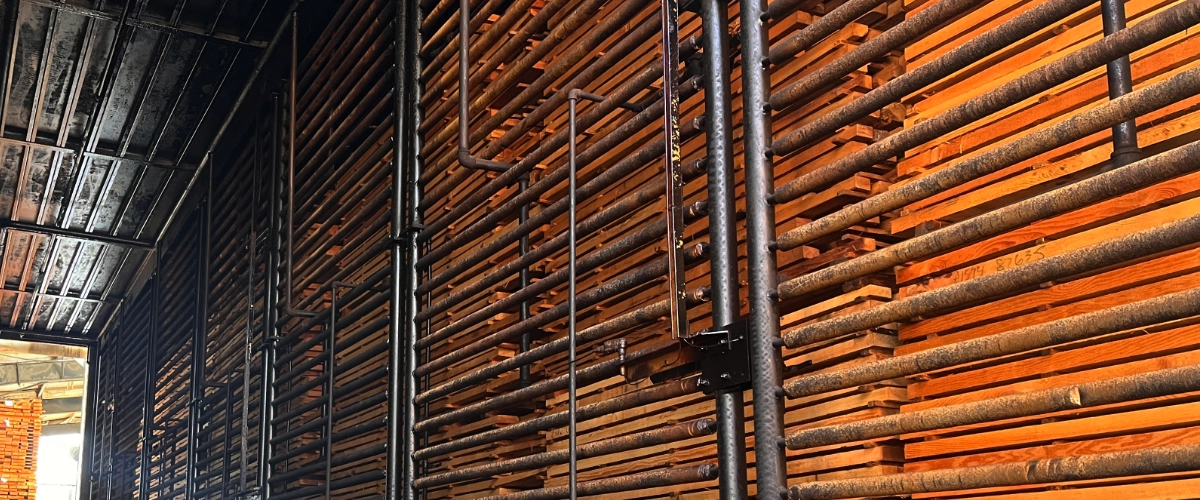
Kiln drying closes that gap by removing the variables. Lumber goes into enclosed chambers where heat, humidity, and airflow are all actively controlled, pushing MC down to levels that outdoor conditions can never reliably produce. The process is also far more predictable on a timeline, measured in days or weeks rather than seasons of yard time. That consistency matters a great deal when you’re running a production schedule.
Here’s where a lot of buyers run into trouble: the “kiln dried” label on retail lumber describes the process, not the result. Real-world testing of retail kiln-dried lumber has turned up average MC readings around 14%, which is perfectly acceptable under the KD19 construction standard but nowhere near suitable for fine millwork or furniture. The lumber was technically kiln dried. It just wasn’t dried to the level the project required.
This distinction matters enormously in practice. When you’re working to dimensional tolerances as tight as 1/64 inch, lumber MC has to be verified and stable before it ever reaches the saw or planer. Wood movement caused by inconsistent MC doesn’t just create cosmetic issues; it blows tolerances entirely. That’s why asking suppliers for documented MC targets and actual testing methodology, rather than just a KD stamp, is a non-negotiable step for precision remanufacturing work. A label tells you how the lumber was processed. Documented MC data from Oregon State extension research on air-shed drying and verified testing tells you whether it’s actually ready for your application.
Species Differences and Regional EMC: The Details That Affect Your End Product
Not all species dry the same way, and ignoring that fact is where a lot of lumber defects originate. Douglas Fir, Hemlock, and Western Red Cedar each behave differently in the kiln, and that difference isn’t subtle. Douglas Fir typically enters the kiln at 30 to 45% MC and requires a staged temperature ramp, starting with milder conditions before pushing toward the target MC. Hemlock is notably more challenging, with green MC levels that can reach 85 to 170% in certain stock, making conservative schedules and pre-sorting by initial MC almost a requirement for consistent results. Western Red Cedar sits on the other end of the difficulty spectrum; it’s lighter and more permeable, so it tolerates faster drying, but it still needs a species-specific approach to avoid surface defects in higher grades.
When a kiln operator uses a generic schedule instead of a species-matched one, the results show up quickly. Drying too fast or at the wrong temperature for the species causes case hardening, where the outer shell dries and locks while the core is still wet. That stress shows up as internal checking, surface cracking, or boards that look fine until they’re machined. A proper conditioning step at the end of the run, using elevated humidity to relieve residual stress, is what separates a serious drying operation from one that’s just moving wood through heat. Species-specific kiln schedules, backed by resources like the USDA Forest Products Laboratory Dry Kiln Operator’s Manual, are a baseline requirement for quality output, not an optional upgrade.
Regional EMC adds another layer to this. Lumber dried to 8% MC works well in an arid Southwest climate, where average EMC can drop below 5% in summer months. That same board installed in a humid Pacific Northwest application will slowly absorb ambient moisture, expanding slightly and potentially causing fit or finish issues down the line. The practical rule of thumb here is straightforward: target an MC within 2 to 4 percentage points of the average annual EMC at the installation site. That range minimizes post-installation movement and reduces the risk of joint failures or dimensional drift.
If you’re sourcing custom lumber for projects across multiple regions or climates, don’t assume a single MC target covers every scenario. Talk to your supplier about species-specific drying schedules, how the equalization step is handled, and whether MC targets can be adjusted to match your destination environment. That conversation is worth having upfront rather than troubleshooting it after installation.
Heat Treatment Alongside Kiln Drying: What It Is and When It Matters
Heat treatment is a phytosanitary process governed by ISPM 15 international standards that requires lumber to reach a core temperature of 56°C (132.8°F) for a minimum of 30 continuous minutes. The goal is to kill insects, nematodes, fungi, and other quarantine pests at every life stage before wood crosses international borders. Over 160 countries enforce these rules, and without documented compliance, shipments can be held, rejected, or penalized at customs.
The reason HT is increasingly bundled with kiln drying comes down to simple practicality. The kiln already generates the heat environment required for phytosanitary treatment, so performing both processes in the same facility is a natural pairing. Many commercial kiln drying schedules already exceed HT time and temperature requirements, meaning the lumber can simultaneously satisfy moisture and compliance targets in a single run. For suppliers serving customers who ship internationally or need ISPM 15-compliant wood packaging materials like pallets and crates, offering KD/HT together is becoming a baseline expectation rather than a premium add-on.
For domestic buyers who never cross a border, HT certification still carries real value. Government contracts, institutional procurement specs, and high-value commercial projects increasingly request documented pest-free assurance as part of their sourcing requirements. The certification adds traceability that protects everyone in the chain.
The key distinction worth emphasizing is this: a supplier stating they can perform heat treatment is not the same as supplying a documented KD/HT certificate. The physical ISPM 15 mark and accompanying treatment records are what customs authorities, inspectors, and commercial contracts actually recognize. Ask for the paperwork, not just the capability claim. Working with a supplier who provides both kiln dry and heat treatment documentation under one roof keeps procurement straightforward and eliminates the friction of coordinating compliance across multiple vendors.
What to Actually Ask a Kiln Dried Lumber Supplier Before You Buy
“Kiln dried” printed on a tag or invoice tells you almost nothing on its own. The real question is what came out of that kiln, at what moisture content, tested how, and documented by whom. Here is exactly what to ask before you commit to an order.
Ask for a specific MC number, not a label. A supplier operating to a precision standard should be able to tell you the exact MC target for your species and application, such as 6 to 8% for interior millwork or furniture components. If the answer is a vague confirmation that they “use a kiln,” that is a signal they are not tracking outcomes with any real rigor. The target matters because species behave differently in the kiln, and the right number for Douglas Fir destined for a climate-controlled interior is not the same as softwood framing lumber headed to a job site.
Ask whether MC is tested at the point of shipment and whether documentation is available. Lumber can re-absorb moisture after it leaves the kiln if it sits in open storage or ships without proper wrapping. You want confirmation that boards were tested post-drying and that results, batch records, or a certificate can travel with your order. A spread of 2% or less across a load is a reasonable benchmark for precision work.
Confirm species-specific drying schedules and regional EMC matching. This is especially relevant for custom millwork, door components, and window parts, where movement after installation is a real problem. Ask whether the supplier can align delivered MC to the equilibrium moisture content of your installation environment. A supplier who understands why kiln-dried lumber is not always what it seems will have a direct answer.
For export or compliance orders, ask about KD/HT certification. Kiln drying and heat treatment are not automatically the same process. If your order crosses an international border, you need documentation confirming the lumber met the ISPM 15 temperature standard, and your supplier should be able to issue that certificate as part of the shipment paperwork.
Check for FSC or PEFC chain-of-custody certification. These certifications confirm that material sourcing is tracked from the forest through the full production chain. They are increasingly required for green building programs and corporate procurement policies, and a supplier who holds them can provide the documentation you need without extra follow-up.
Prime Forest Remanufacturing is built around exactly these requirements. Four kilns with full KD/HT capabilities, tolerances held to 1/64 to 1/32 inch, FSC and PEFC certifications, and more than 75,000 custom product configurations combine into a precision remanufacturing process designed for buyers who need verified outcomes, not just a label on the board end.
The Bottom Line on Moisture Content and Kiln Dried Lumber
At this point in the guide, the core pieces are in place. Interior and precision work targets 6–8% MC, construction framing allows up to 19%, and the “kiln dried” label on its own tells you almost none of that. Kiln drying is a controlled process that requires documented targets, consistent testing, and verified results to actually deliver the stability your project depends on. A commodity supplier dries to a threshold and moves on. A precision supplier documents every load, tests for case hardening, matches the species to the correct drying schedule, and can tell you exactly what MC left the kiln.
Before your next purchase, ask for the actual MC range for the batch, the testing method used, and how the species and target MC align with your regional equilibrium moisture content. Those details are what separate lumber that performs long-term from lumber that moves, gaps, or warps after installation.
If you have a custom application that requires specific MC targets, species selection, or tight tolerances, the team at Prime Forest Remanufacturing is ready to work through the details with you. Reach out to discuss your project requirements and get lumber built to the spec your application actually needs.
Conclusion
Understanding moisture content is not complicated once you know what the numbers mean. Remember these key takeaways: a “KD” stamp is a starting point, not a finish line; moisture content requirements vary significantly depending on your specific application; and acclimating lumber to your environment before cutting is one of the simplest ways to protect your work long-term.
The difference between a project that lasts decades and one that fails within a year often comes down to this single variable.
Grab a quality moisture meter if you do not already own one. Test every board before it goes into your project. Give your lumber time to settle. These small habits take minutes but save hours of frustration and rework.
Build with intention, start with dry wood, and the results will speak for themselves.